
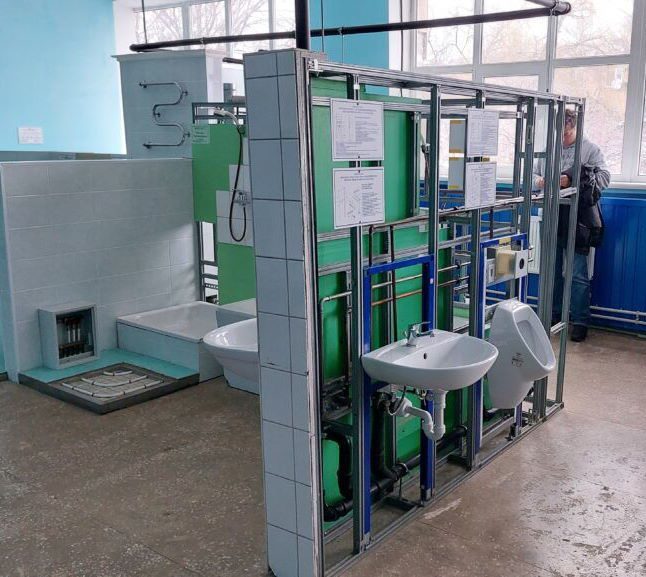
For a long time, plumbing was associated with something unattractive. No one wanted to study to become a plumber because it was believed that you had to work for a pittance amongst the dirt and sewage. The Chernihiv Professional Lyceum of Railway Transport set out to overcome this stereotype, at least at the local level. To do this, it was necessary to show Chernihiv youth the real world of plumbing technologies: the machinery and equipment used by vocational instructors, modern solutions for kitchens and bathrooms, and heating systems.
This is where the Ukrainian-Swiss project to improve plumbing education was of great assistance to the lyceum. The first step was to create a powerful training and practical centre. The next step was to update the content of plumbing education, develop new teaching materials, and pay attention to the professional qualifications of teachers.
Maksym Pohzharyi, director of the Chernihiv Vocational Lyceum of Railway Transport, shares his impressions of participating in the project and ideas that will help develop not only the institution but also the region as a whole in the future.
On the project’s impact
The Chernihiv lyceum was one of six institutions selected for the first phase of the project to improve plumbing education. The logistical facilities impacted the quality of training of plumbing students, as well as the attractiveness of the lyceum in the eyes of applicants.
“The project has brought a wide range of improvements. One of them is an increase in the number of applicants to our lyceum for plumbing. At the same time, interaction with employers has improved. They have seen that by cooperating with a vocational education institution, they can order training for the personnel required at a particular enterprise. And then there would be no need to retrain or re-train novice workers. In addition, if earlier the customers for plumbers were mainly utilities, after we upgraded our material and technical base, private construction companies became interested in us. Now, such companies are more likely to hire our students for internships and then invite them to work,” says the lyceum director.
On entrepreneurship education
The entire region and the city of Chernihiv in particular have suffered greatly due to Russian aggression. Many businesses lost their facilities and relocated to relatively safe regions.
“Even before the war, the Chernihiv region was lacking a powerful employer which would become our primary partner company. Plumbers here either work independently or look for teams that hire construction companies to carry out certain work. Since the outbreak of a full-scale invasion, the labour market has been experiencing unprecedented challenges. So, in addition to regular employment, we promote the idea of starting their own business among our students. We want them to consider this option for their career trajectory. To do this, we hold lectures for lyceum students together with the Employment Centre and services that provide legal support for business start-ups. We are talking about applicants for various professions. In addition to explaining the legal side of the issue, we tell them where to look for clients, how to arrange for supplies and get discounts from suppliers,” says the lyceum director.
The VET school says that the key indicator will be graduates who successfully start their own business.
On adult education
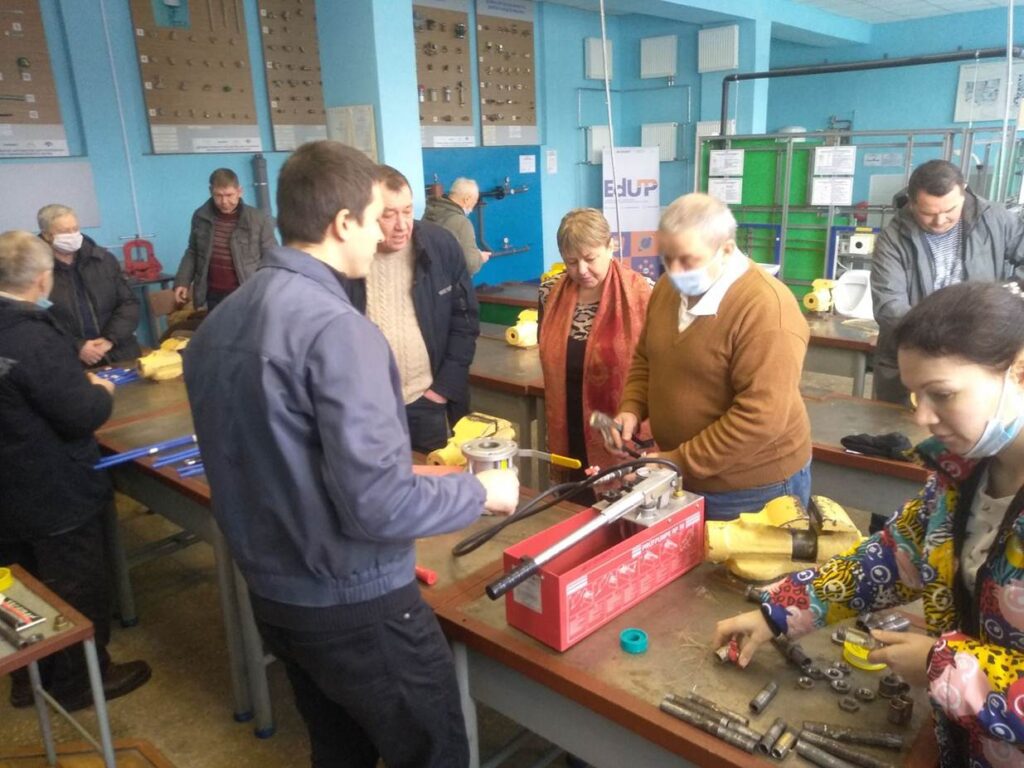
Thanks to the new logistical facilities, the lyceum recruits 4 groups of adults studying. This training is a paid service and allows us to cover the cost of consumables for students and to update the equipment in the training centre.
If successful, the training graduates receive a certificate.
On the training of principals
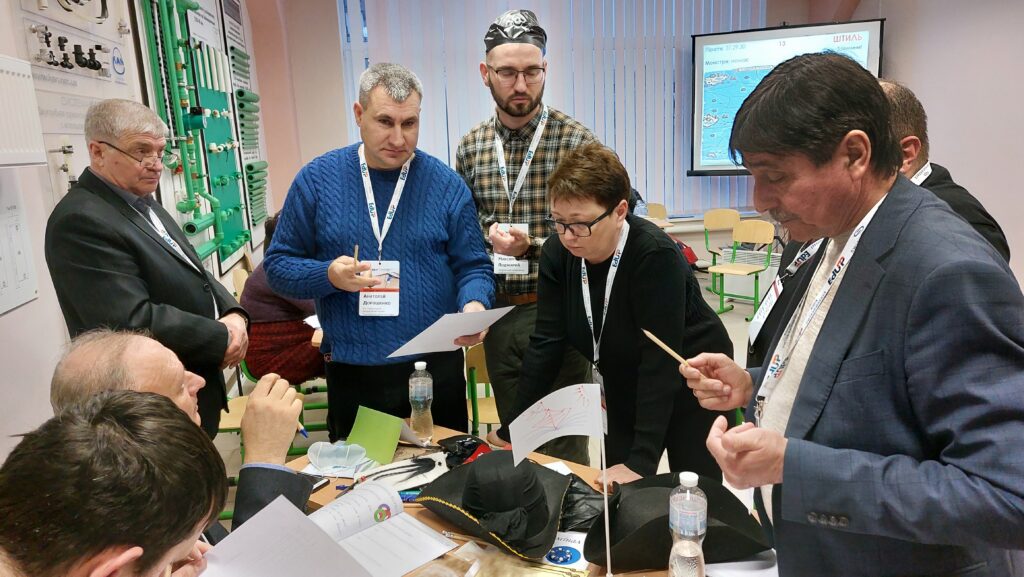
“Personally, as a manager, the EdUP project helped me build a systematic approach to each task. We took a lot of trainings, in particular, on building effective communication with the team. It turned out that learning can be interesting and really practical. I then shared the knowledge I had gained with the team,” explains Maksym Podzharyi.
At the end of 2022, the lyceum participated in the development of a business plan. The idea was to set up a business centre within the institution. The centre was to provide housing construction and renovation services, primarily for those whose homes had been damaged by Russian military action. Since the work would be part of the students’ work experience, the cost of the services would be lower than the market price. In addition, vocational instructors would be involved in the tasks. For all parties, it would be an additional income and an opportunity for development.
“Writing a business plan helped to establish communication within the VET school. Some employees proved themselves to be the best in this matter: they offered interesting and promising ideas and thought of ways to implement them. Now, after the de-occupation of Chernihiv region, many security issues have arisen that cannot be postponed. But I hope that in the future there will be a place for development projects that will be useful not only for the lyceum but also for the city,” says Maksym Podzharyi.
About the support from EdUP
Since the beginning of the full-scale invasion, the EdUP project has been supporting the Chernihiv Professional Lyceum of Railway Transport. As the building of the institution was damaged by a missile hit nearby, the project provided resources to restore the heating system.
In addition, the institution appreciates participation in educational and practical conferences, workshops, and trainings that allow educators to improve their skills.
What would you like to see in the future?
“In training workers, in particular plumbers, we need to focus on business needs. As an option, this can be done through dual-form education. Personally, I like the German model of dual education. The employer is the key player there. It influences the ratio of practice and theory in the educational process. It is most convenient to work in a dual form with a business that is a monopolist in its field. But when it comes to a network of small or medium-sized enterprises, the problematic issues grow exponentially. Why not approach it from the other side: involve construction companies that use sanitary ware, for example, only from Geberit. That is, we would start from the fact that these companies are different in terms of capacity, but have the same approaches and logistic facilities. We could effectively expand the number of employer partners and show businesses an effective way to train skilled workers,” said the lyceum director.
The VET school would also like to develop international mobility among students. This would allow young people to explore European approaches to workplace organisation and learn about trends in the plumbing industry.
***
The Public-Private Partnership to Improved Plumbing Education (EdUP) is a project of the Swiss Agency for Development and Cooperation, in partnership with Geberit Trading LLC, implemented by Swisscontact Foundation for Technical Cooperation and supported by the Ministry of Education and Science of Ukraine.